B2B SAAS · INTERNAL TOOLING · DECISION SUPPORT
A decision-support interface for post-auction operations at their most complex. Twelve lot states, three handling paths, and the principle that the system carries the process so the user carry the decision.
The work continues after an auction closes. Every unsold lot needs a next step, whether relisted, returned to the consignor, or donated, each with its own rules and operational impact.
At Skeleton, this process had no system support. Status labels existed in the interface but held no underlying logic. Relisting a lot created a duplicate record with the same serial number, making it impossible to identify which version was current.
Auctioneers relied on memory, manual coordination, and cross-system navigation to manage post-auction work.
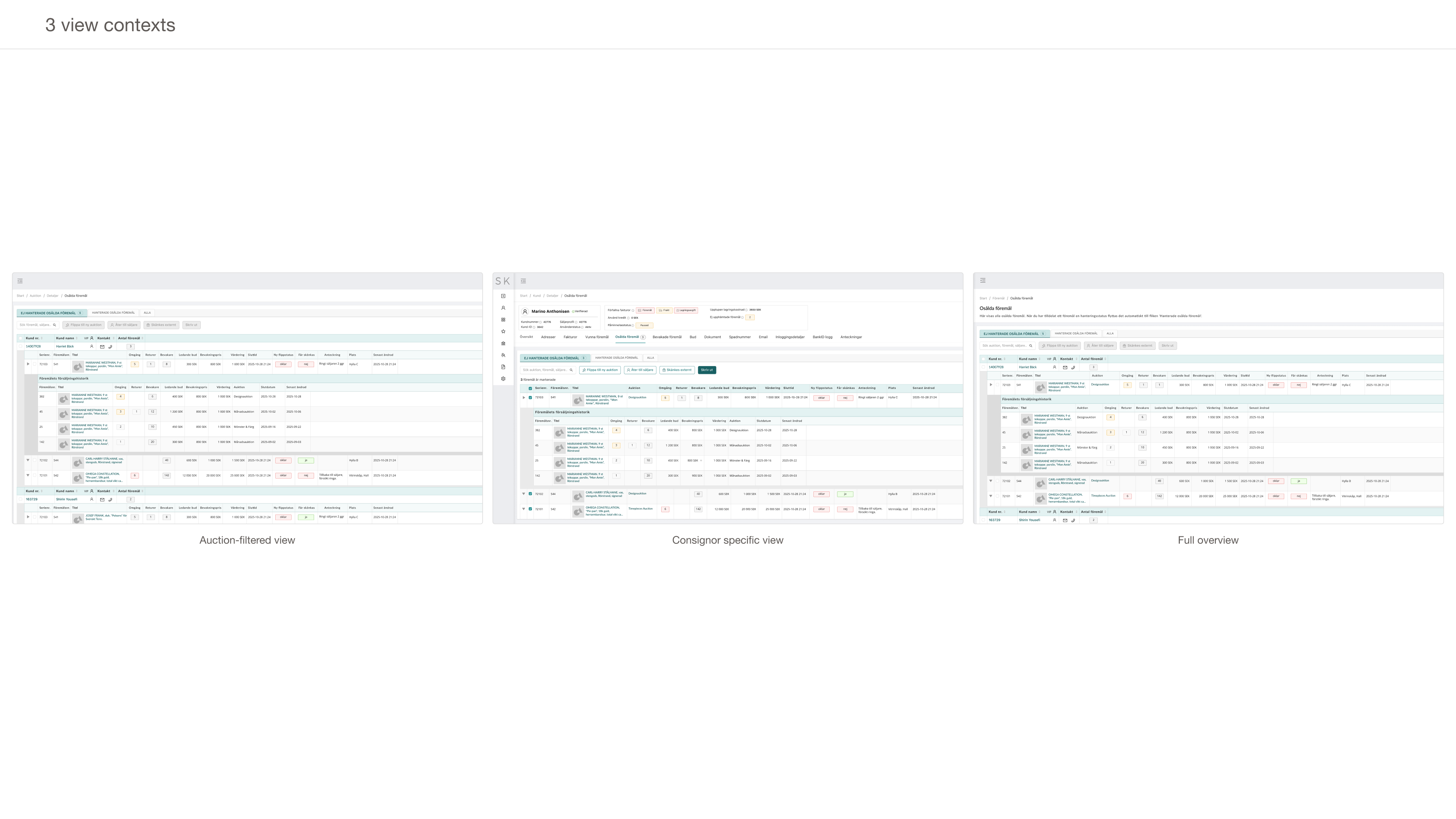
The scope was shaped by the research. The redesign covered the unsold lots interface within an auction, a new view on the customer detail page surfacing all unsold lots for a single consignor, and a global overview spanning the entire platform.
Automation was designed into the MVP. Key actions trigger system-handled communication flows, removing manual follow-up from the auctioneer's workflow. Together, these three contexts covered every operational situation where auctioneers needed to act on unsold inventory.
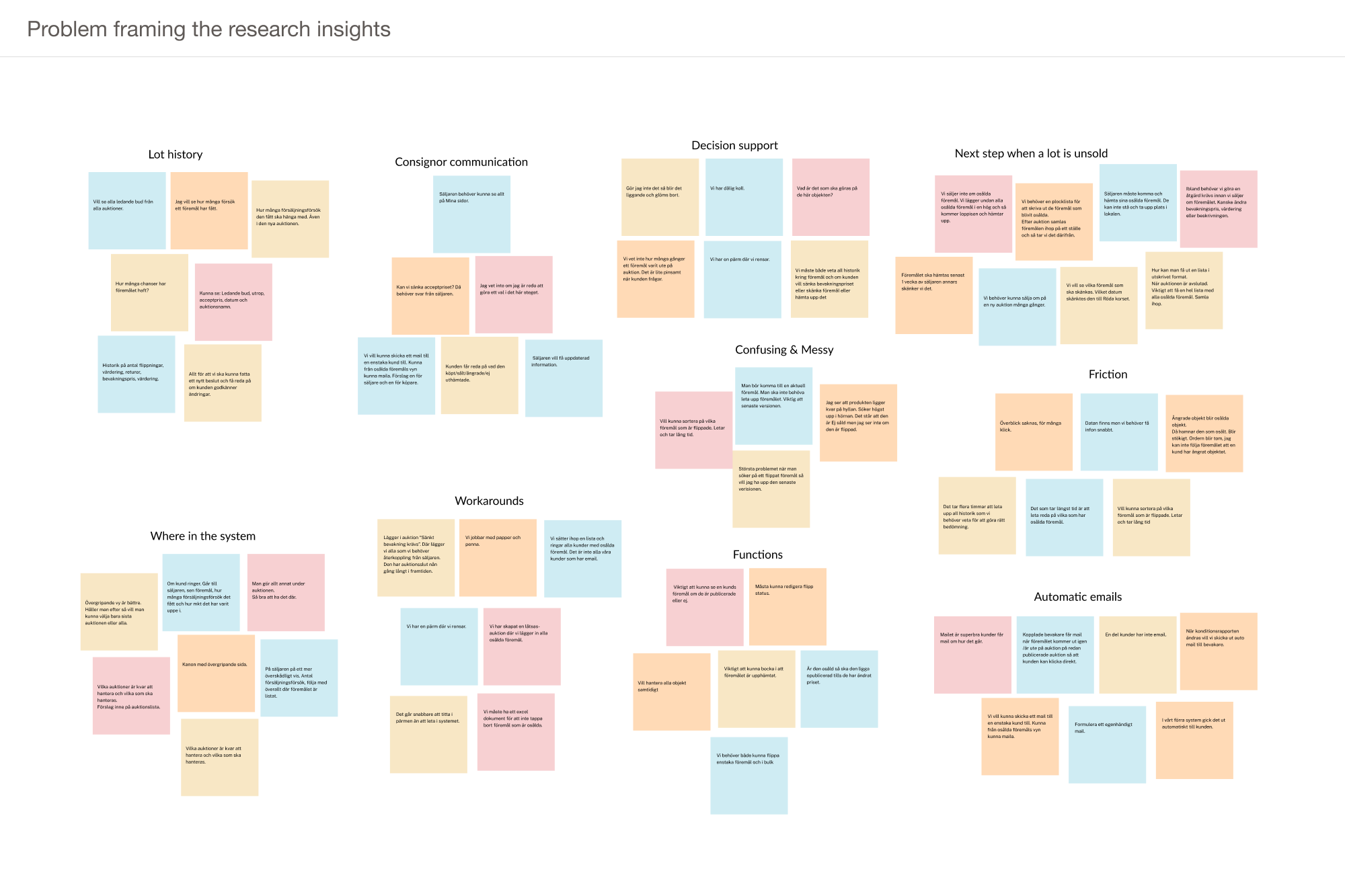
Research came first. I ran a cross-functional discovery spanning customer support, engineering, and the business, alongside user interviews at several auction houses, to build a shared understanding of the problem. The insights reshaped the brief from managing unsold lots to helping auctioneers make confident decisions at scale. Problem framing, process diagrams, and visual information architecture preceded the design work.
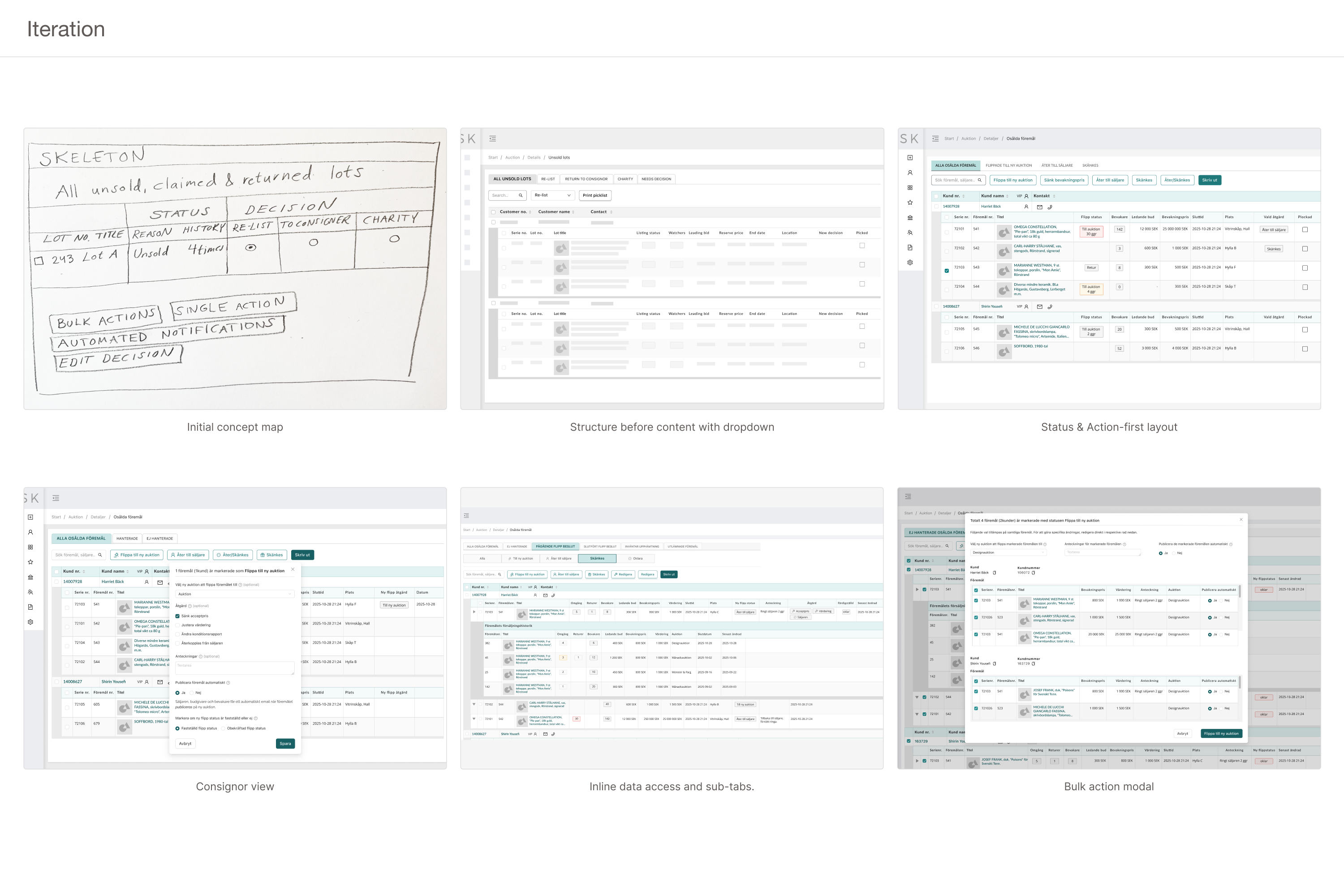
More than fifty wireframes across six concepts led to nine prototypes covering three core flows in three operational contexts, reviewed by the product owner, development team, and several auction house customers.
Every unsold lot sets off a chain of decisions. Auction house staff needed to balance consignor communication, inventory handling, and accurate records, but the platform provided little guidance or support.

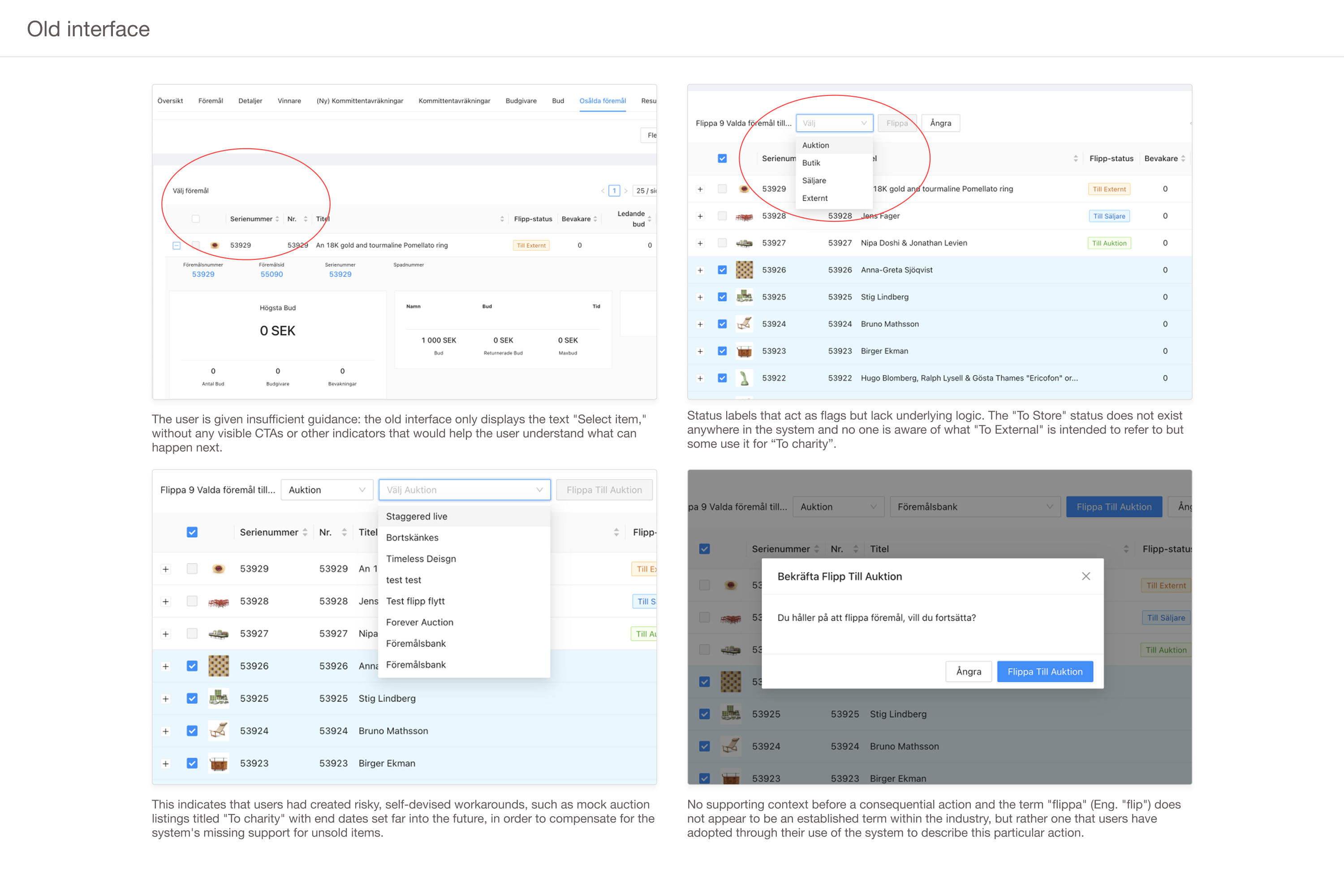
The existing interface: lot status spread across multiple screens without consignor context visible at the moment of action.
Unsold lots were assigned status labels, but those labels were not backed by any real system logic. Actions such as relisting simply triggered a flag instead of updating the underlying state. Relisting also created a duplicate record with the same serial number, making it impossible to identify which version was current. As lots moved between auctions, they lost their history. Previous listings, estimates, and outcomes were no longer connected. The result was more than a usability issue. It compromised data integrity and made post-auction work increasingly difficult for every auction house using the platform.
The gap between what the system supported and what the business needed was filled with manual work. Teams created dummy auctions to move and track unsold lots that the platform could not handle, while auctioneers switched between multiple systems just to gather enough context to process a single lot. There was no shared overview of unsold inventory at the consignor level, making it difficult to communicate status or plan the next steps. Delays in handling also led to lots piling up in physical storage, creating operational bottlenecks beyond the system itself. Without a structured workflow, every decision depended on manual coordination, and each auction house developed its own way of working.
The impact reached far beyond inefficient workflows. Many auctioneers worked under constant time pressure and had limited technical confidence, making an already complex process difficult to manage. Some customers were actively considering alternative platforms because the day-to-day work had become too cumbersome.
The lack of reliable system support also affected relationships with consignors. Auction house staff using the platform could not always answer simple questions like Where is my item? or What happens next? with confidence, undermining trust in the service. What started as an operational challenge had clear business consequences, affecting customer satisfaction, retention, and the platform's competitiveness.
Research revealed the problem was not workflow friction. It was the absence of a workflow. Seven auction houses across Europe were running the same workarounds independently, each believing it was a local problem.
Cross-functional research was the point of departure. Customer support, developers, and business stakeholders each held a different piece of the problem. Bringing those perspectives together built the shared understanding the design work needed and pointedto where deeper research was required.
Three themes emerged from the research. Decision-making was fragmented. Auction house staff had to gather information from multiple places in the system before they could act on a single lot, and many relied on manual workarounds to keep track of things the system should have managed. Important information was difficult to access. The data existed, but finding the right context required unnecessary steps and slowed down everyday work. Routine tasks were almost entirely manual. Without consistent workflows or interaction patterns, repetitive work took longer than necessary and increased the risk of mistakes.
“Some of the data is already in the system, but it requires too many clicks. We need the information quickly. We can’t go into every individual order to search. We need an immediate overview, not to have to look in ten different places.”
Södersens Auktioner · Uppsala
“For large estates, I need to track all remaining items and pending actions at the customer level. It’s crucial to see all of a client’s unsold lots in one place, regardless of which auction they originally belonged to.”
Olséns Auktioner · Norrköping
The original brief focused on improving how unsold lots were managed after one specific auction. Research pointed to a broader challenge. Auction house staff needed support for confident operational decisions, alongside the consistent workflows that would make automation possible. That shift shaped the direction of the project. The goal was to surface the right data at the right moment, adding more context where decisions required it while keeping each view focused on what was relevant. Research also showed that a single auction-based view fell short of how most users actually work. Auction house staff managing multiple active auctions need a consignor-level view and a full system overview to ensure no lot is overlooked.

Critical user quotes informing and driving design decisions.
What began as an interface improvement turned into a deeper redesign of the underlying workflow, data model, and decision logic.
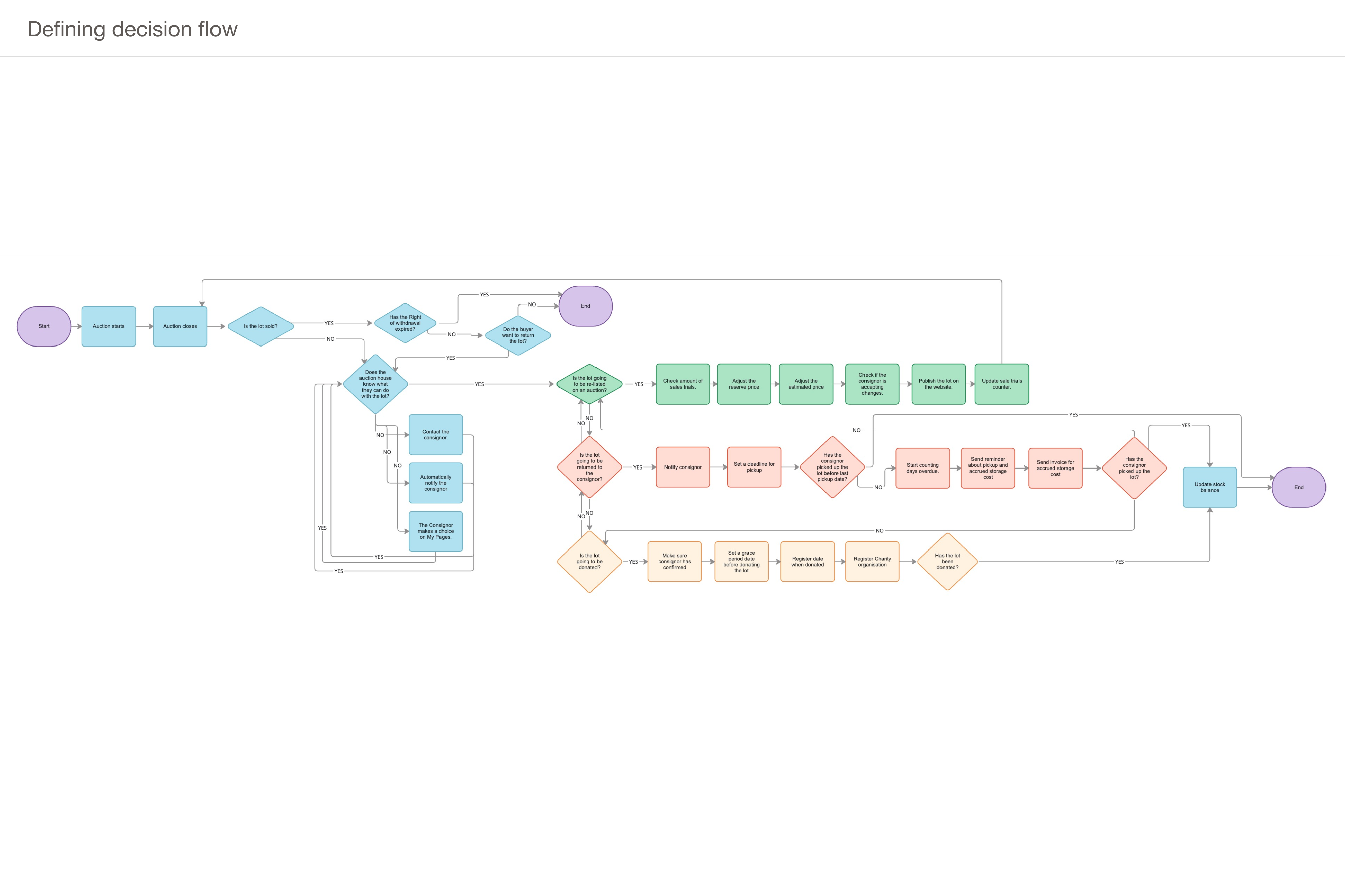
Before designing the interface, I mapped every possible path an unsold lot could take after an auction. The goal was to understand what information auction house staff needed to make each decision and how each action affected the next step in the process. The mapping revealed far more complexity than the interface suggested. A lot could be re-listed, returned to the consignor, donated to charity, or routed through several other paths, each with its own rules, dependencies, and operational consequences. The flow was rarely linear. A lot could move between states, return to earlier stages, or require multiple decisions before reaching resolution. This became the foundation for the project. By understanding the decision logic first, I could design workflows that reflected how the business actually operated rather than simply improving the existing interface.
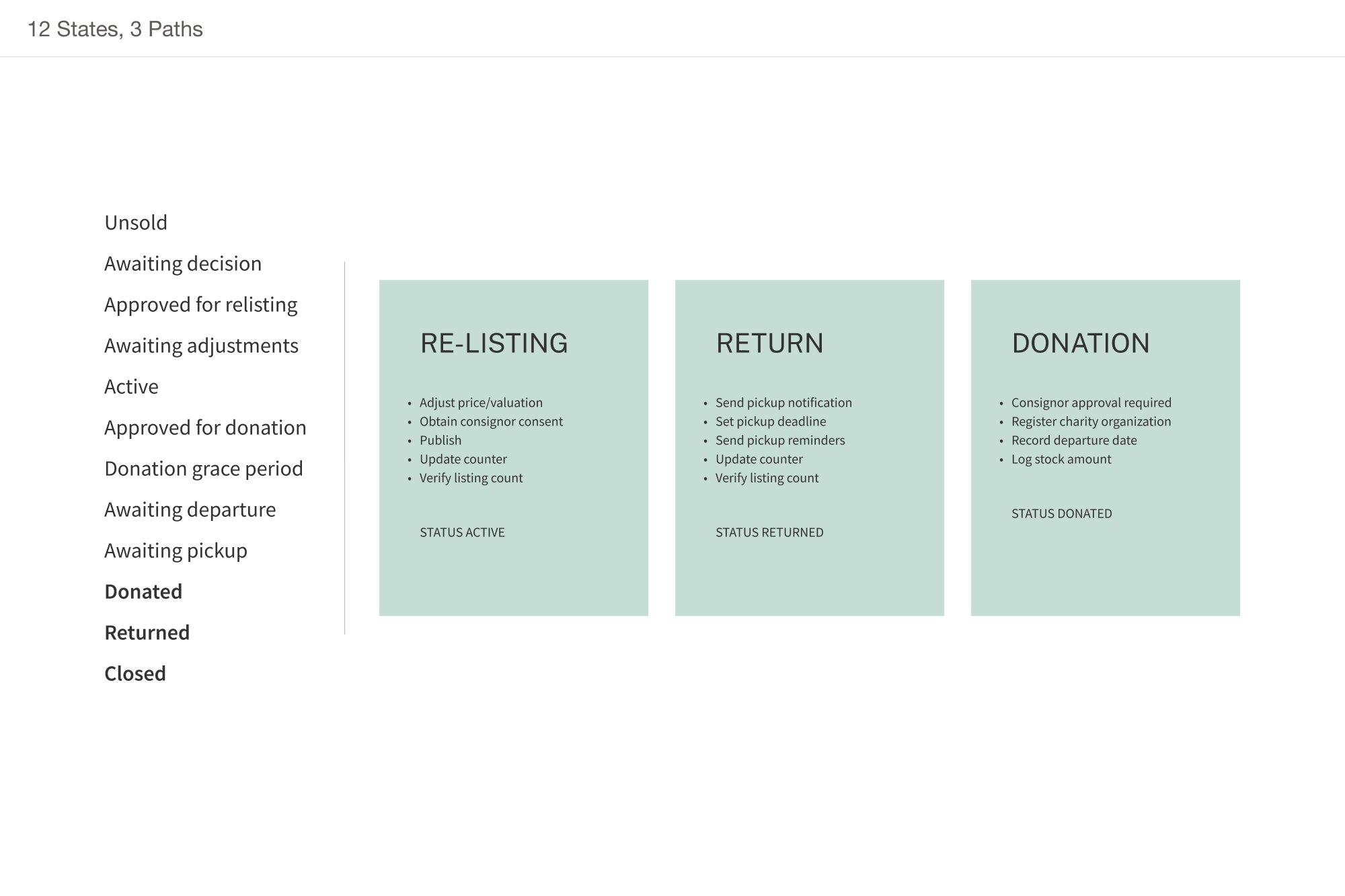
I defined how lots move between states, clarifying what should happen automatically, what requires user action, and where human confirmation is needed. The result was a twelve state model built around how post-auction work actually unfolds. State granularity was a deliberate design decision. Similar actions were grouped under shared states where the underlying system behaviour was identical, reducing navigational complexity without losing operational clarity. Lifecycle stages were surfaced as top-level navigation so auction house staff could see where every lot stood at a glance. Automation was built in from the start. A single action triggers the full communication chain to sellers, bidders, and watchers. The user completes one task and the system handles the rest.

Before designing the interface, I mapped every possible path an unsold lot could take after an auction. The decision tree covered three colour-coded workflows for relisting, returning items to consignors, and donations. Each workflow had its own branching logic, conditions, and system-triggered actions. This mapping became the foundation for the interaction design and ensured every scenario was accounted for before moving into UI.
The original brief underestimated the complexity of the problem. Research revealed needs that were outside the initial scope, including automation, a consignor overview, and bulk actions. These were core requirements, each essential to making the workflow usable. Expanding the scope made prioritization critical. With a small team, the challenge was deciding what to build first. I facilitated an MVP scoping workshop to align stakeholders around a shared plan for the first release. Together, we prioritized the three core post-auction workflows, the consignor overview, and the underlying state model that would support future development. More advanced capabilities, including automation and AI-assisted recommendations, were intentionally deferred until the foundation was in place.
Designed for a specific situation, each of the three views draws on the same twelve-state model. The auction view helps staff manage active auctions day to day. The consignor view brings together all of a consignor's unsold lots across auctions, so staff can communicate faster and act on lots from several auctions at once. The system overview gives a full picture of inventory and flags anything that needs attention. Each view has its own information hierarchy and data points, selected for the decisions that matter in that specific context, without splitting the system into disconnected parts.
Each lot carries extensive historical data, including prior auction listings, estimates, condition notes, and consignor information. Some items may have passed through multiple auction rounds, each with its own bids, reserves, and outcomes. Showing all of this by default would overwhelm the interface at the point where decisions need to be made. I designed a hierarchy of tabs and sub-tabs to progressively disclose information, surfacing what matters first and keeping deeper detail one step away. I also introduced an inline sales history drawer within the table, allowing the user to access full lot history without losing context or navigating away from the list view.
Accessibility was treated as a user need rather than a compliance checklist. Research revealed that many auction house staff are older and work with reduced vision, making contrast and legibility central design requirements. Each state in the twelve-state model is conveyed through both colour and label, ensuring the interface remains usable regardless of colour vision. All interactive elements across tables, modals, and workflows were designed to meet WCAG AA contrast standards and support full keyboard navigation.
Skeleton operates across multiple markets, which means interface elements must also work in languages where text can expand significantly compared to Swedish. Structural decisions, including tab hierarchy, column design, action placement, and modal behaviour, were made with text expansion as a core constraint rather than an edge case. This reinforced the importance of an information architecture based on structure and hierarchy rather than fixed copy length.
Finding the right information hierarchy required exploring more than fifty wireframe screens across six concepts. Each concept tested a different answer to the same core question of what auction house staff need to see before making a decision, and what can be deferred. Early versions exposed too much information at once, while later iterations explored progressive disclosure, status-led layouts, and action-led interfaces. Each round was explicitly tied to research input, with frames labelled by iteration and interview reference to maintain traceability between findings and design decisions.The final direction prioritized immediate visibility of status and pending actions, with supporting context available one step deeper in the interface.

Over fifty wireframe screens across six concepts, each testing a different answer to the same question: what must an auctioneer see before they can act in a certain situation and what can wait?
The solution translates a complex post-auction workflow into a set of structured, decision-focused interfaces. Each flow is designed to surface the right context at the right time, reducing manual coordination and helping auction house staff act with confidence across different operational situations.

Three view contexts from one research finding: auction-filtered, consignor-specific, and system overview — each surfacing what the auctioneer needs at that moment.
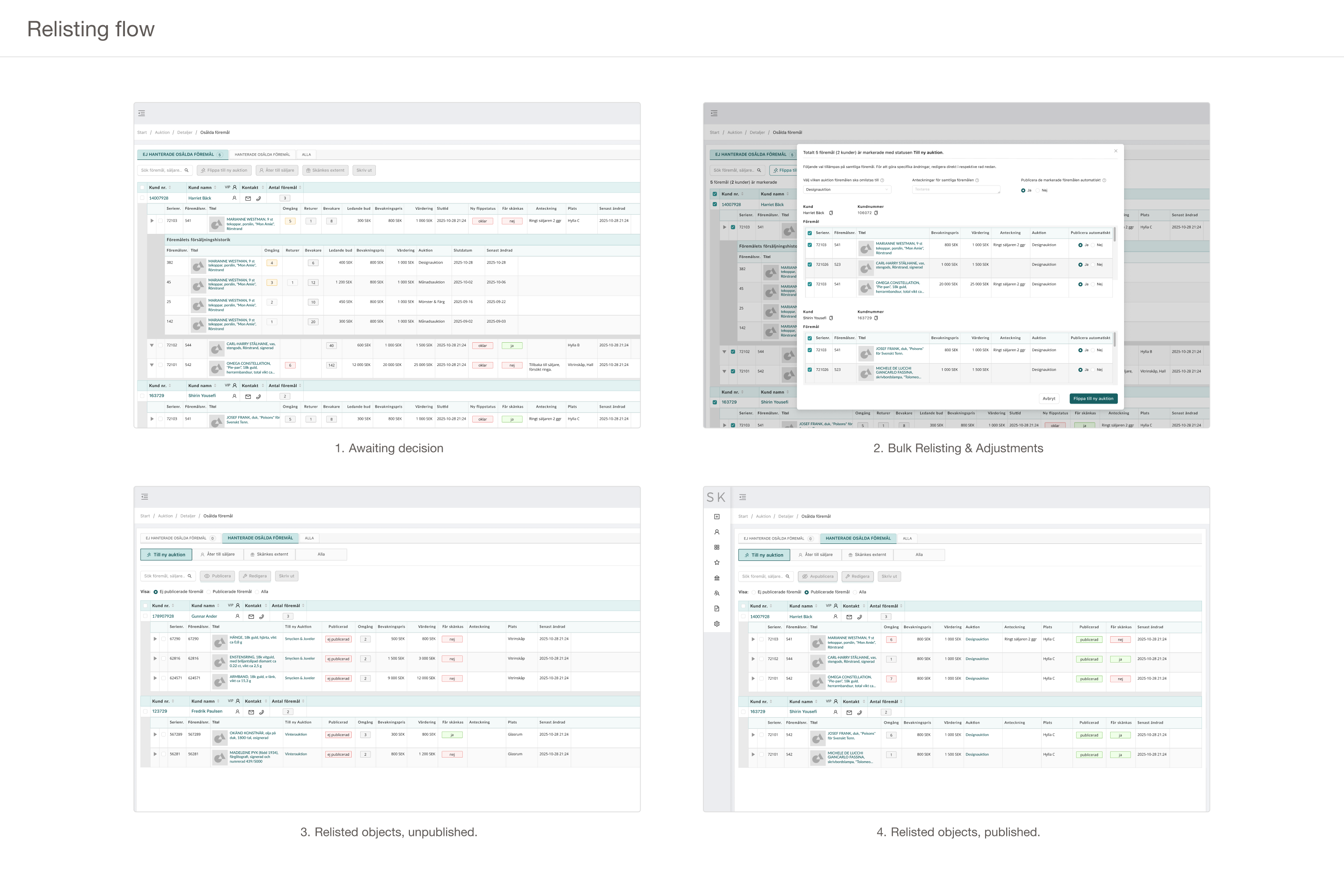
When relisting an unsold lot, the interface surfaces the key context needed for the decision, including previous estimates, prior auction listings, current condition, and comparable recent sales. Instead of requiring users to gather information across the system, the flow brings everything into one place and guides the decision directly in context. The system then handles the state transition automatically, removing the duplicate record issue present in the previous implementation.
When a lot is marked for return, the system automatically notifies the consignor and sends follow-up reminders. The user confirms the decision, while the system handles the coordination.This replaces a manual process where auction house teams had to track collection status and manage communication across multiple touchpoints.
Relevant context surfaced before the decision, state transition handled by the system, automated seller communication triggered on confirmation. One action by the auctioneer; the rest follows.
When a lot is marked for donation, the user selects the recipient organisation and sets a grace period before the decision is finalised. The grace period accounts for consignors who change their mind, a situation that emerged directly from user interviews. The flow preserves the customer relationship while removing the need for teams to coordinate approval windows manually.
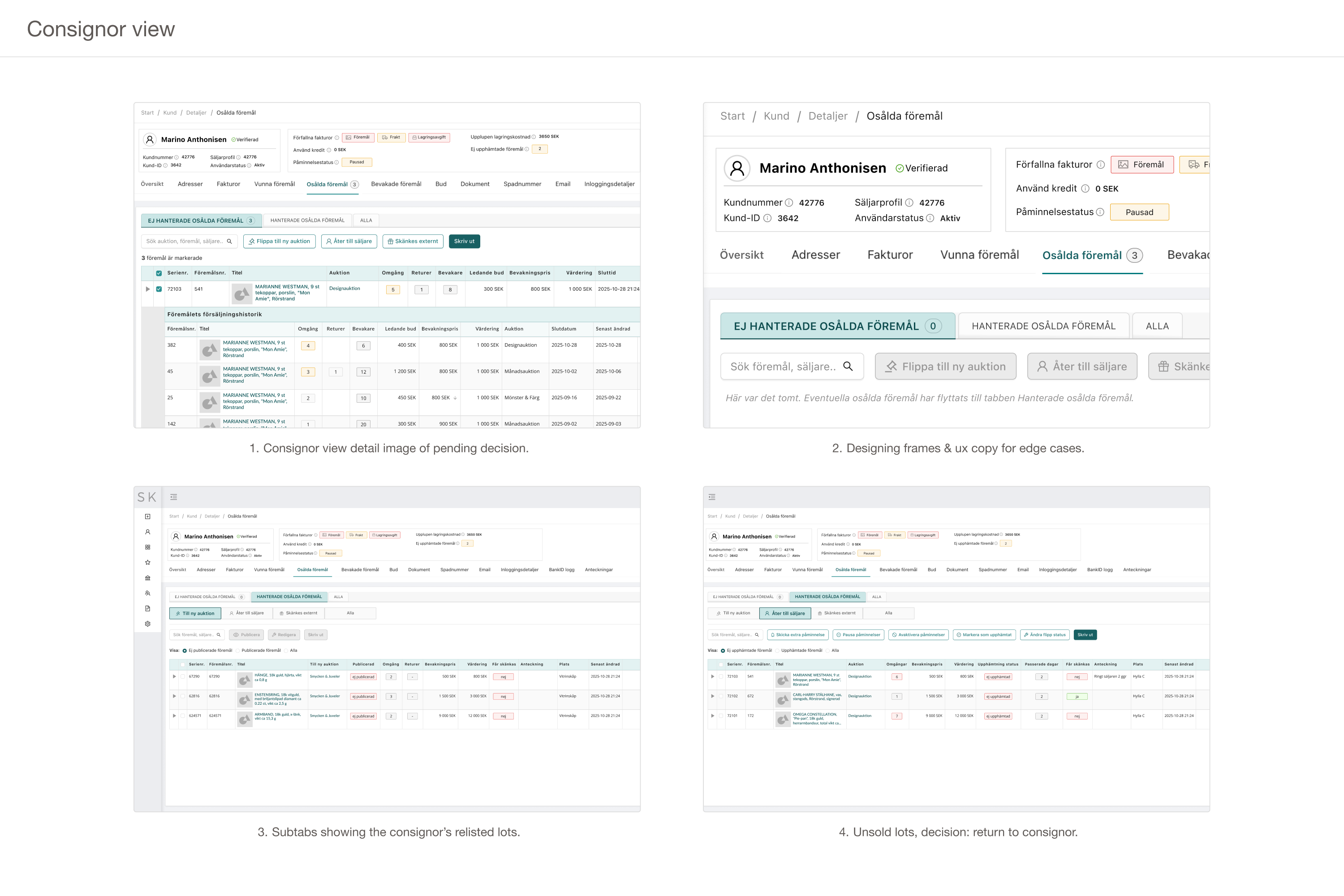
The consignor view brings together all unsold lots for a single seller across multiple auctions, along with their current status and any pending actions. It also supports bulk operations, allowing the user to manage multiple items in a single flow. This is particularly relevant for consignors such as companies or estates with hundreds of items spread across several auctions. Bulk actions are structured to remain transparent and controllable at scale. Items are grouped by consignor in a single review step, with the ability to adjust individual lots before confirming all changes together. This turns what was previously a sequence of repetitive actions into one coordinated decision. Edge cases were also designed intentionally. Instead of showing an ambiguous empty table, the interface presents a clear empty state when a seller has no unsold lots, making the absence of data a meaningful and understandable condition rather than a potential error.
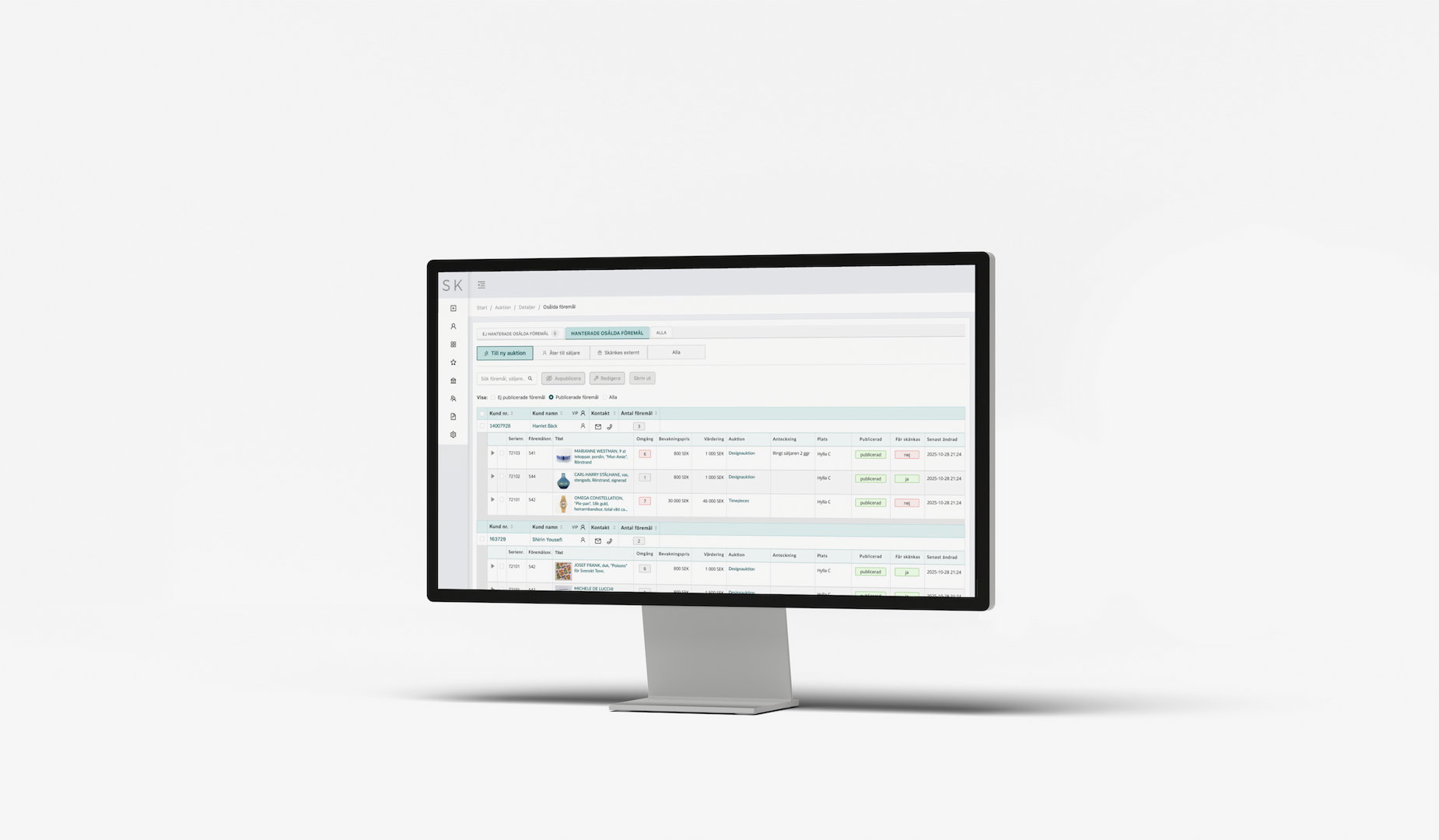
The system overview brings together lots that span multiple auctions and consignors, giving the user a single place to track inventory and identify items that need attention. Rather than forcing users to switch between auction or consignor views, the interface supports cross-platform workflows through flexible filtering. Auction, consignor, and status filters can be combined to quickly narrow down the relevant inventory, regardless of where a lot originated. This view emerged through research and edge case testing, which showed that some operational tasks could not be fully supported within the auction or consignor views alone. It completed the workflow by providing a system-wide perspective when broader visibility was needed.

The relist flow: from lot in 'Awaiting decision' state through context review and adjustments to confirmation and relisting on a new auction. The system handles the state transition and automated seller-communication and the auctioneer makes the decision.

Consignor-level view, added in direct response to research. Auction houses managing large estates needed all of a seller's unsold lots in one place, across auctions. Edge cases and UX copy designed to handle the full range of data density.

Twelve lot states defined before any screen was designed, including parallel states where a lot is simultaneously active on a new auction and pending in the handling workflow. The model the previous system had not attempted to represent.
This project went beyond solving a workflow problem. It established a scalable foundation for future development while improving how auction house staff make decisions every day.
The project transformed a fragmented, manual post-auction process into a structured workflow that auction house staff could trust. Instead of relying on workarounds, duplicate records, and institutional knowledge, users gained a clear view of each lot's status and the context needed to make confident decisions. The solution was validated with the product owner, the development team, customer success and several auction house customers, including Södersens Auktioner, Olséns Auktioner, Laholms Auktioner, and Ystads Auktioner. Customers described the redesigned workflow as a significant improvement over the auction platforms they had previously used, highlighting the clearer workflows, better overview, and reduced manual effort. The development team also confirmed that the solution was technically feasible and aligned with the platform architecture. The underlying state model and workflow architecture established a foundation for extended future automation and AI-assisted decision support without requiring fundamental changes to the system.
Before launch, the team agreed on a set of success metrics to evaluate whether the redesign delivered the intended outcomes. The first priority was to eliminate duplicate records, confirming that the new state model resolved the underlying data issues. Beyond that, success would be measured by how quickly users could complete post-auction decisions, how often they needed to switch between systems to find information, and how much routine work could be handled through automation instead of manual coordination. The team also agreed on operational targets: reducing the volume of unsold lots occupying auction house storage, lowering the number of times an individual item was relisted, and making it possible to take action on items that had failed to sell across multiple auctions. Together, these metrics measured more than efficiency. They reflected whether the new workflow helped users make faster, more confident decisions.
My role As Product Design Lead, I owned the project from discovery through delivery. I led research, reframed the problem, facilitated stakeholder workshops, defined the workflow and information architecture, and designed the end-to-end experience.
Beyond the interface, I shaped the product direction by defining the state model, facilitating MVP prioritisation, and aligning business goals, user needs, and technical constraints with cross-functional teams. Throughout the project, I collaborated closely with product, engineering, customer success, and auction house customers to ensure the solution was both valuable to users and feasible to build. The solution was approved for implementation. All three post-auction workflows within the auction view formed the MVP, with the consignor view and system overview prioritized for the next development phase.
This project challenged many of my assumptions about designing complex products. Beyond delivering a solution, it reshaped how I approach product strategy, systems thinking, and designing for confident decision-making.
This project fundamentally changed how I approach designing complex products. Early on, I realised the real challenge had little to do with improving an interface. It was about understanding the decisions the interface needed to support. Once we reframed the problem from managing unsold lots to enabling confident operational decision-making, many design questions became easier to answer. The interface became the outcome of a well-defined workflow rather than the starting point.
It also reinforced that effective product design goes beyond accommodating every request. Users naturally propose solutions based on the limitations of the tools they know. My role was to uncover the underlying need, challenge assumptions, and prioritise solutions that created long-term value over short-term feature additions.
Another key takeaway was the importance of systems thinking. In products with interconnected workflows, even small design decisions can have far-reaching consequences across the user experience, technical implementation, and future scalability. Investing time in understanding the end-to-end ecosystem, its relationships, dependencies, and edge cases, made it possible to make more intentional design decisions that aligned user needs with business goals and engineering realities.
Most importantly, this project strengthened my belief that confidence is a product outcome. In operational tools, success is measured by more than the number of clicks removed. It is measured by how clearly the product guides people toward the right decision. When users work under pressure, reducing uncertainty often creates more value than adding functionality.